Ready to get started?
Get Demo


Scientists at the National Laboratory of the Rockies (NLR) compared Artemis AI-generated solar access values against drone-acquired measurements from Exactus Energy across 100 rooftop locations on seven buildings in California and Texas.
The study found Artemis statistically equivalent to the drone measurements at the portfolio level at the strictest tolerance tested, ±1 solar access value (SAV) point, and uniformly equivalent at margins of ±3, ±5, and ±10 SAV points.
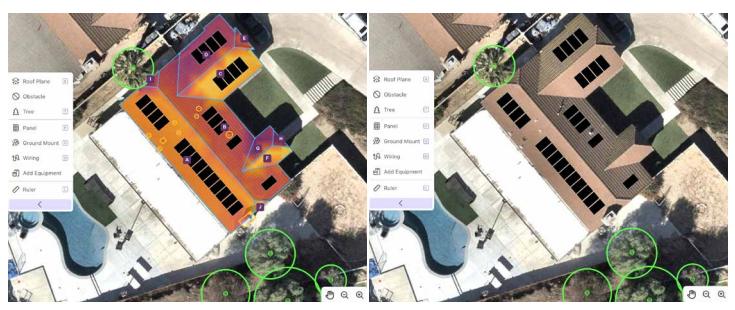
Solar access values measure the usable solar resource available at a specific rooftop location by accounting for shading and sky obstruction. They are an important input for system design, panel layout, production estimates, and customer proposals.
Exactus Energy collected SAV measurements through drone-based site surveys at 100 rooftop locations across California and Texas. Artemis generated SAV estimates for the same locations and time periods using its remote AI-based modeling.
Researchers compared the two datasets across:
To determine whether the differences were practically meaningful, researchers used the Two One-Sided Tests procedure with equivalence margins of ±1, ±3, ±5, and ±10 SAV points.
The analysis also accounted for the fact that measurements from the same rooftop and adjacent months are related rather than completely independent.
Across locations and time periods, the average difference between the Exactus drone measurements and Artemis estimates was small.
More importantly, the statistical uncertainty around that difference remained within the study's tightest equivalence margin of ±1 SAV point.
At the annual level, both California and Texas were found statistically equivalent at every margin tested:
The study therefore concluded that Artemis SAV estimates were statistically equivalent to Exactus Energy's drone-acquired measurements under the tolerances evaluated.
Traditional SAV collection can require a technician or drone operator to physically visit a property.
Artemis instead uses computer vision, remote data, 3D rooftop modeling, and simulations of shade patterns throughout the year to generate SAV estimates remotely.
The NLR results show that those remotely generated estimates can achieve practical accuracy equivalent to drone-acquired measurements, including at the study's strictest ±1 SAV threshold.
Solar exposure and shading change throughout the year, so the researchers did not rely on a single annual comparison.
They evaluated monthly measurements as well as summer, winter, and annual summaries. The results supported equivalence across those timeframes, providing evidence that the findings were not limited to a particular season or snapshot in time.
The study provides independent evidence that AI-generated solar access values can serve as an alternative to labor-intensive, on-site measurement workflows without sacrificing the quality of a key system-design input.
For solar and roofing contractors, that can mean faster rooftop assessments, lower soft costs, and shorter project timelines while maintaining confidence in the data used for system design and proposals.


