Ready to get started?
Get Demo


A prepaid solar lease lets a homeowner pay once, upfront, for 20 to 25 years of solar while a third-party owner holds the system and claims the Section 48E commercial tax credit. That credit comes back as a lower price, often around 30% below a cash purchase according to EnergySage, with no monthly payments and a path to ownership after year five. With the homeowner tax credit gone, it is the biggest discount most of your customers can get in 2026.
This guide is for installers and the lenders who fund them: how prepaid works, what it saves, when the homeowner owns the system, which disclosure rules apply and how to pitch it.
A third-party owner (TPO) buys the system you install and claims the Section 48E Clean Electricity Investment Credit. The homeowner prepays for the system's use (a prepaid lease) or its power (a prepaid PPA), and the TPO builds the credit into that one price.
The residential 30% credit, Section 25D, is not available for property placed in service after December 31, 2025, so cash and loan buyers get no federal credit. A TPO can still claim 48E: 6% base, up to 30% when wage and apprenticeship rules are met, plus 10 percentage points each for domestic content and energy communities. Under IRS Notice 2025-42, solar projects that began construction after July 4, 2026 must be in service by December 31, 2027.
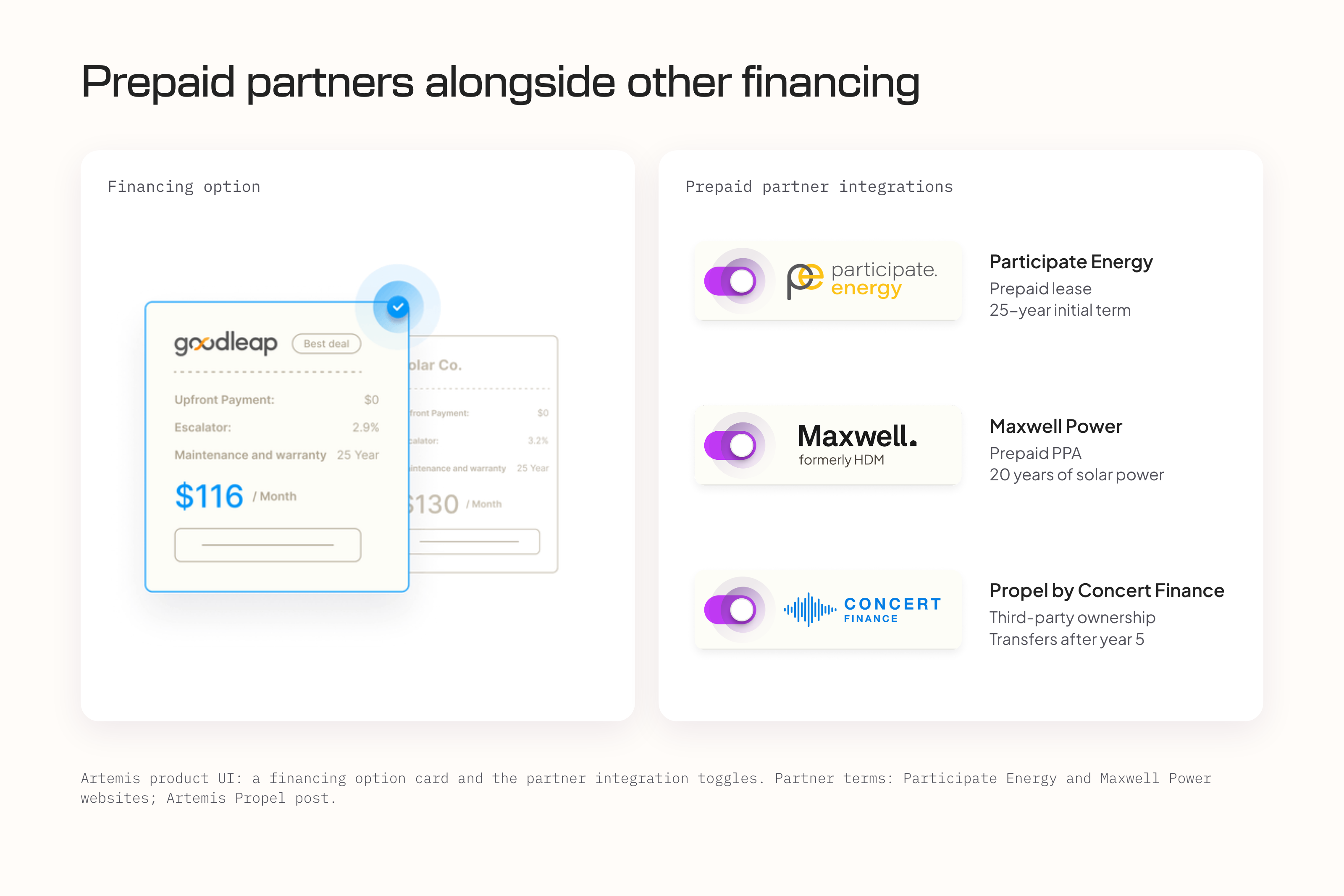
The partners differ in what is prepaid. Maxwell Power sells a prepaid PPA covering 20 years of guaranteed solar power. Participate Energy sells a prepaid lease with a 25-year initial term. Propel by Concert Finance keeps the system with a third-party owner for five years, then transfers it to the homeowner.
Expect roughly 20% to 30% off the cash price, and more where bonus credits stack. Solar.com puts the typical discount at 20% to 30%, EnergySage says around 30%, and Propel can cut total system costs by up to 30%, or up to 40% in energy communities.
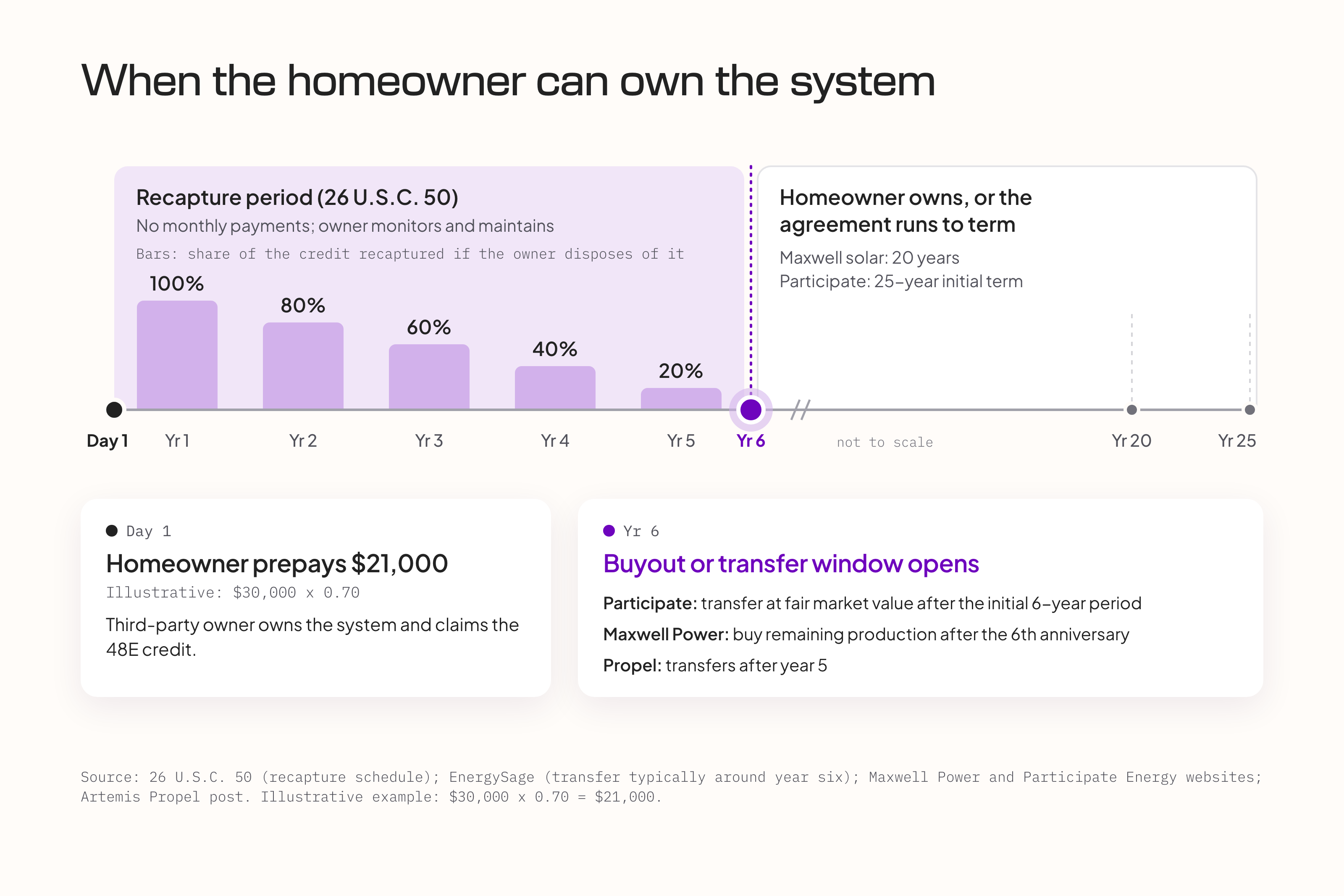
On an illustrative $30,000 system at a 30% discount: $30,000 x 0.70 = $21,000, paid once. That is $9,000 less than cash. If the homeowner finances the prepayment, the loan starts at $21,000 instead of $30,000, a smaller principal for the lender on the same system.
A traditional loan moves the other way. The CFPB found that hidden dealer fees typically add 10% to 30% to the cash price; its own example turns a $30,000 system into a $39,000 loan before interest.


A standard solar lease is a contract, typically 20 to 25 years, where the homeowner pays a monthly fee to use a system the solar company owns. The company keeps the tax credit, and many leases raise the payment 1% to 3% a year.
A prepaid lease replaces 240 to 300 monthly bills (20 or 25 years x 12) with one payment and no escalator, and ownership opens after year five instead of at the end of the term. A PPA bills per kWh rather than a flat fee; a prepaid PPA covers those kWh upfront. For the bigger picture, see why more solar companies are choosing TPO and PPA over cash or traditional financing.
After year five, usually at the start of year six. Under Section 50 of the tax code, if the owner disposes of the system in the first full year, 100% of the credit is recaptured, falling to 80%, 60%, 40% and 20% through year five. So the TPO holds for five years.
Participate offers transfer at fair market value after the initial 6-year period. Maxwell lets customers buy the remaining years of production after the sixth anniversary. Propel transfers after five years. EnergySage notes that contracts typically transfer at fair market value set "in good faith" by the provider, so never promise a $0 buyout the contract does not state.
Prepaid deals are still leases and PPAs, so state third-party ownership rules apply in full. Four examples:
California. The CSLB requires the Solar Energy System Disclosure Document in boldface 16-point font on the front or cover page of every contract, before completing a sale, financing or lease.
Colorado. Leases and PPAs signed on or after July 1, 2026 need a written disclosure of no more than four pages, at least three business days to cancel and a recorded welcome call (Mayer Brown).
Nevada and Oregon. Nevada's SB 379 and SB 440 require a recorded call with the homeowner before installation. Oregon's HB 4029, effective June 5, 2026, adds disclosure rules for sales, leases and PPAs (same source).
Lead with it. Show prepaid first, then cash, loan and standard lease on the same design, so the only thing that changes is how the homeowner pays.
A simple talk track: "Buying this system is $30,000, and homeowners no longer get a federal tax credit. With a prepaid lease, a solar company owns it for five years and claims a business credit, so you pay $21,000 once, with no monthly payment. After year five, you can own it."
Then handle the objections:
Participate Energy, Maxwell Power and Propel are available inside Artemis, so a rep can design, qualify and show prepaid pricing without opening another portal. The Participate integration shows the prepaid lease alongside other financing in real time, and Presentation Mode keeps that comparison clean in front of the homeowner.
No. A third-party owner holds the system for at least five years and claims the 48E credit. The homeowner gets the discount now and can own the system after year five.
Not directly. Section 25D ended after 2025, so the credit now reaches homeowners only as a lower lease, PPA or prepaid price.
It depends on the contract. The buyer may assume the agreement, or the seller may negotiate an early buyout, per EnergySage.
As long as TPO providers can claim 48E. Solar projects that began construction after July 4, 2026 must be in service by December 31, 2027.
Book a free demo to see Participate Energy, Maxwell Power and Propel prepaid pricing next to cash and loan in a single Artemis proposal.


