Ready to get started?
Get Demo


A roof report is a measurement document that tells you the size and shape of a roof before anyone climbs a ladder. It lists total area in squares, the pitch of each facet, the length of every ridge, hip, valley, rake and eave, the flashing runs, and a waste table with suggested squares. Area tells you how many shingles to buy, edges tell you how many accessories, and the waste table tells you how much extra to order.
Most pages ranking for this term sell reports without explaining them. This guide walks each line, shows the math that turns it into a material order and a price, then shows how the Artemis roof report handles it.
A roof report, also called a roof measurement report, is a set of diagrams and totals built from aerial imagery that measures every plane and edge of a roof. It is not a roof inspection report, which documents condition and damage. You use a measurement report to order materials and price the job.
CertainTeed's Shingle Applicator's Manual says an estimate needs two things: roof area, and the lengths of the eaves, ridges, hips, rakes and valleys. A report hands you both without a tape.
Start with total area and convert it to squares. One square is 100 square feet, so a 2,683 sq ft roof is 2,683 ÷ 100 = 26.83 squares before waste.
Next, read pitch. A 6/12 facet rises 6 inches for every 12 inches of horizontal run. Check every facet, not just the predominant pitch. Low slopes need different underlayment: Owens Corning recommends its WeatherLock G ice and water barrier over the entire deck on 2:12 to 4:12 roofs. Flag steep facets too if you charge more for them.
Pitch is also why a report beats a tape on the footprint. Sloped area = footprint x pitch factor, where pitch factor = √(12² + rise²) ÷ 12. At 6/12 that is √180 ÷ 12 = 1.118, the same factor in CertainTeed's slope table. A 2,400 sq ft footprint at 6/12 is 2,400 x 1.118 = 2,683 sq ft, the 26.83 squares above.

Edge lengths drive the accessory order. IKO's estimating guide ties starter strips, drip edge, hip and ridge shingles and valley material to the lengths of eaves, rakes, hips, ridges and valleys.
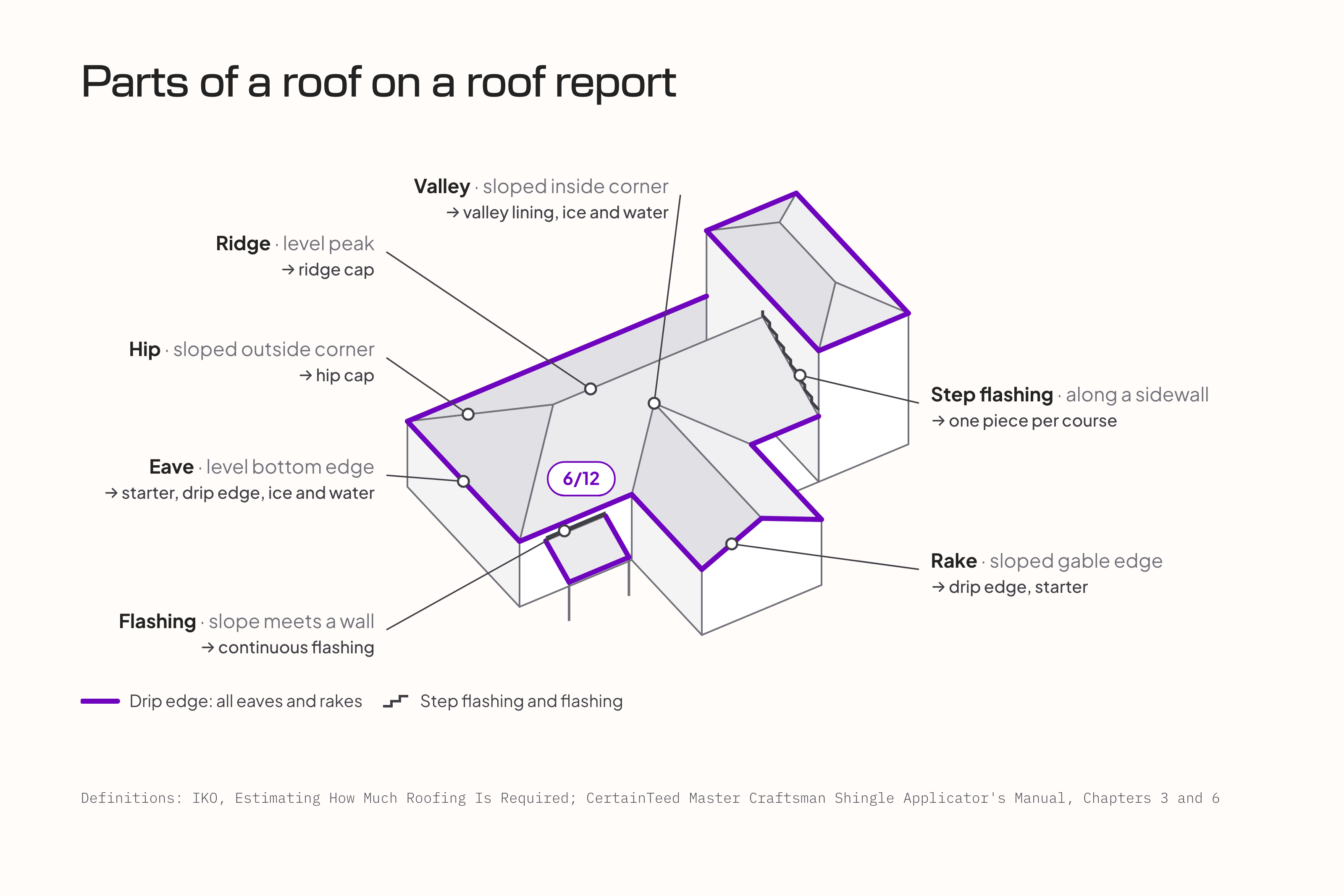
Drip edge is eaves plus rakes. CertainTeed's manual quotes the 2018 IRC: drip edge goes at the eaves and rake edges of shingle roofs.
Flashing is where a slope runs straight into a wall. Step flashing is where a wall runs up the slope, with one piece per shingle course: pieces = length in inches ÷ exposure. At a 5.625 inch exposure, 24 ft is 24 x 12 ÷ 5.625 = 51.2, or 52 pieces.
The waste table lists total area and squares at several waste percentages, with one marked as suggested. Pick the column that fits the roof and crew. If it covers field shingles only, add starter and cap separately: CertainTeed counts starter, hip and ridge, cutting waste and crew waste as separate parts of the total.
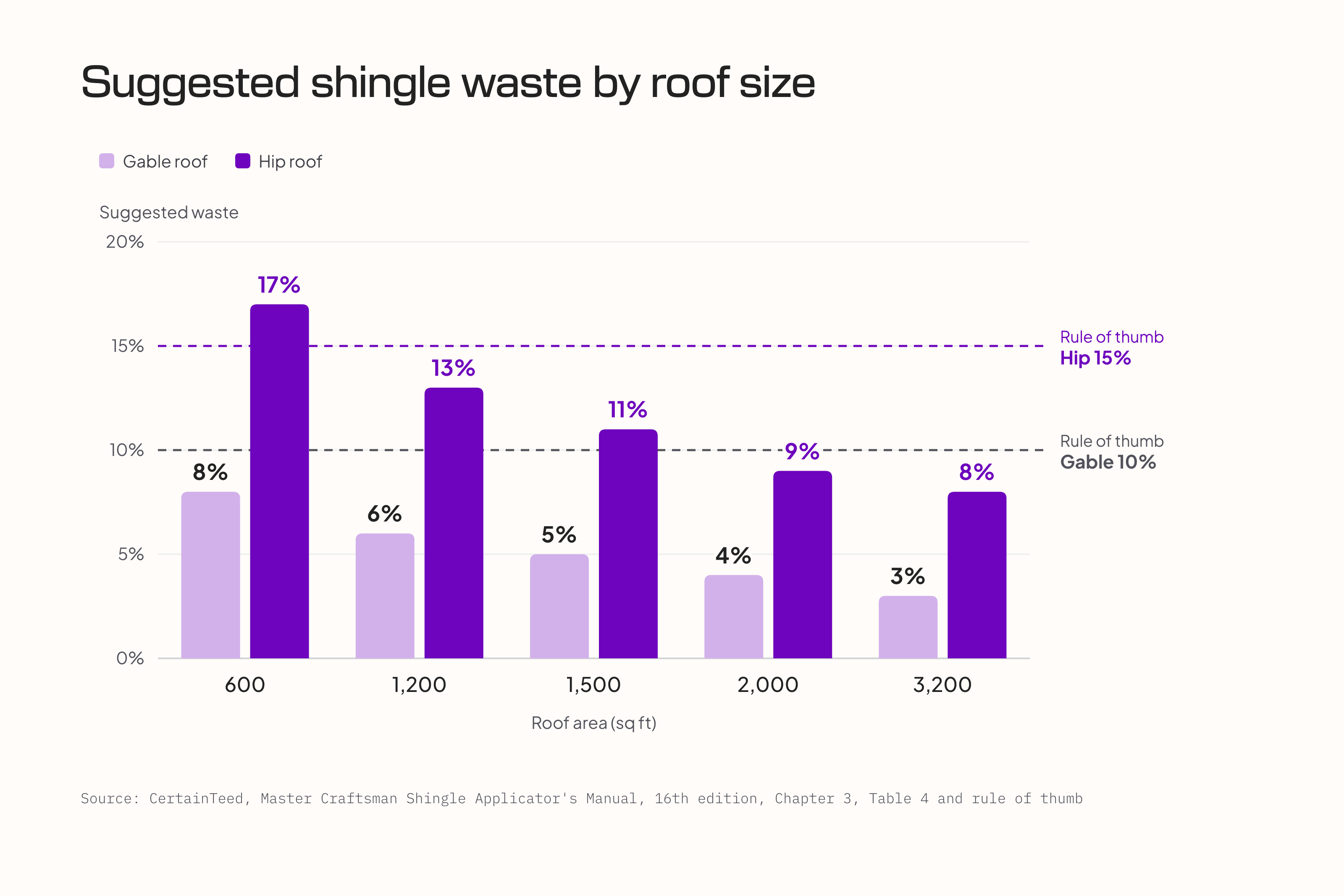
Waste is lowest on big, simple roofs. CertainTeed's rule of thumb is 10% for a gable and 15% for a hip, but its table runs from 8% (gable) and 17% (hip) at 600 sq ft down to 3% and 8% at 3,200 sq ft.
The manual also suggests ordering one extra square per job for material damaged in handling.
Take the hip roof with an ell from CertainTeed's estimating chapter: 1,610 sq ft at 6/12, with 108 ft of hips, 36 ft of ridges, 36 ft of valleys, 168 ft of eaves and no rakes.
To price it, multiply squares by your price per square, add accessories, then add steep or two-story charges.
Artemis measures the roof and carries the numbers straight into the proposal. Artemis returns roof measurements in about 7 seconds. A full roof report costs $5.75 to $12, ESX file included.
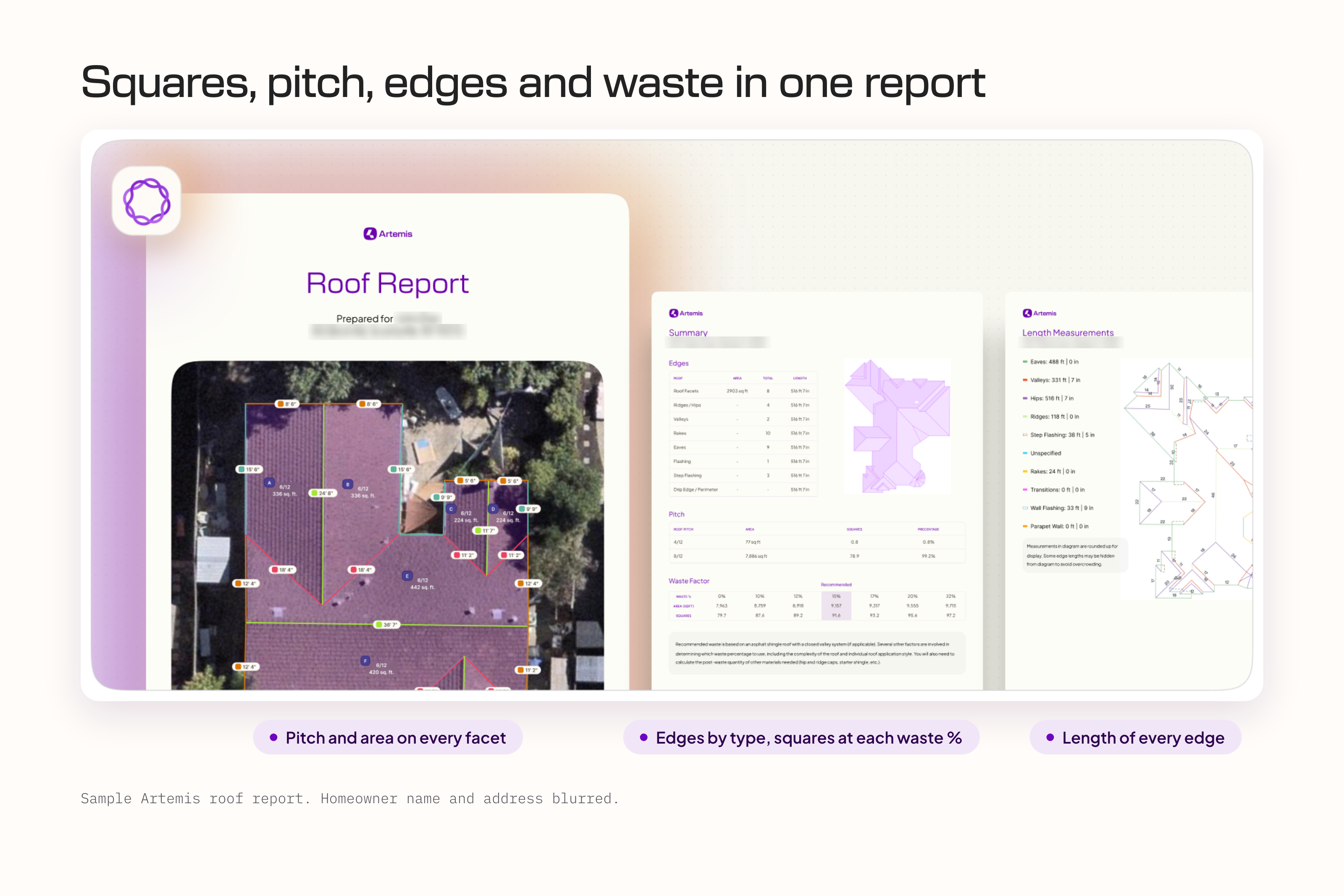
Our roofing page shows what the report covers: measurements, squares, edges, waste and pitch, with a 3D editor for every plane and material. The report breaks out every edge by type, from ridges, hips and valleys to rakes, eaves, flashing and step flashing, and shows squares at each waste percentage.
The Shingle Visualizer shows homeowners new shingles on their own roof in real time and reprices from measured area and waste. Solar reps can add a reroof with Instant Roofing Quotes and present it in Presentation Mode. Artemis also generates ESX files for insurance claims, and every plan includes unlimited users and unlimited contract signing. See Artemis Roofing is here.
Area and squares, pitch per facet, edge lengths, flashing runs and a waste table.
Divide total area by 100, add waste, then round up.
Start with the report's suggestion. CertainTeed's rule of thumb is 10% for gables and 15% for hips, less on large roofs.
Book a free demo to see an Artemis roof report turn into a priced, financed proposal on one of your own jobs.


