
Ready to get started?
Get Demo


To size a solar battery, pick the goal, find the kWh the battery must deliver, and divide by each unit's usable kWh. For backup, that is critical loads in kWh per day times days of backup; for time-of-use savings, it is the evening peak load your solar can't cover. Then check power separately, because kW and kWh are different limits.
BloombergNEF found that about 40% of new residential solar systems had a battery attached in the first three months of 2026, up from an average of 35% in 2025, as Bloomberg News reported in CPA Practice Advisor. Yet most solar battery calculators online size off-grid banks in volts and amp-hours. Here is the grid-tied method, with every formula and two worked examples. The product side is in our interval data and battery sizing release.
You size a solar battery in five steps: goal, energy, usable capacity, efficiency and power.
1. Pick the goal. Backup keeps critical loads running in an outage. Time-of-use (TOU) shifting stores midday solar for expensive evening hours. Self-consumption stores surplus solar instead of exporting it.
2. Find the energy to deliver. Per load, watts x hours ÷ 1,000 = kWh per day. Backup energy = critical kWh per day x (backup hours ÷ 24). TOU energy = peak-window kWh minus the solar produced in that window.
3. Convert to usable capacity. Required usable kWh = energy x (1 + margin) ÷ share available. The margin covers aging and cold, since Tesla and FranklinWH rate capacity at 25°C at beginning of life. Share available is what's left after the homeowner's backup reserve: 0.80 for a 20% reserve.
4. Apply round-trip efficiency. With capacity listed in AC kWh, losses land on the charging side: charge kWh = energy ÷ efficiency. Confirm the array can refill it daily.
5. Check power. kWh is how long; kW is how much at once. Continuous kW must cover loads running together, and the load-start rating must be at least the biggest motor's locked rotor amps (LRA). Units = the larger of required kWh ÷ kWh per unit and peak kW ÷ kW per unit, rounded up.
Divide required usable kWh by each unit's kWh, do the same for kW, and take the larger count, rounded up.
The average U.S. residential customer bought 10,791 kWh in 2022, according to the EIA, so one day is 10,791 ÷ 365 = 29.6 kWh. With no sun, that is 29.6 ÷ 13.5 = 2.2, so three 13.5 kWh units, or 29.6 ÷ 5.0 = 5.9, so six 5.0 kWh units. A critical-loads panel cuts that, which is why the goal comes first.
Per unit, from each manufacturer's datasheet:
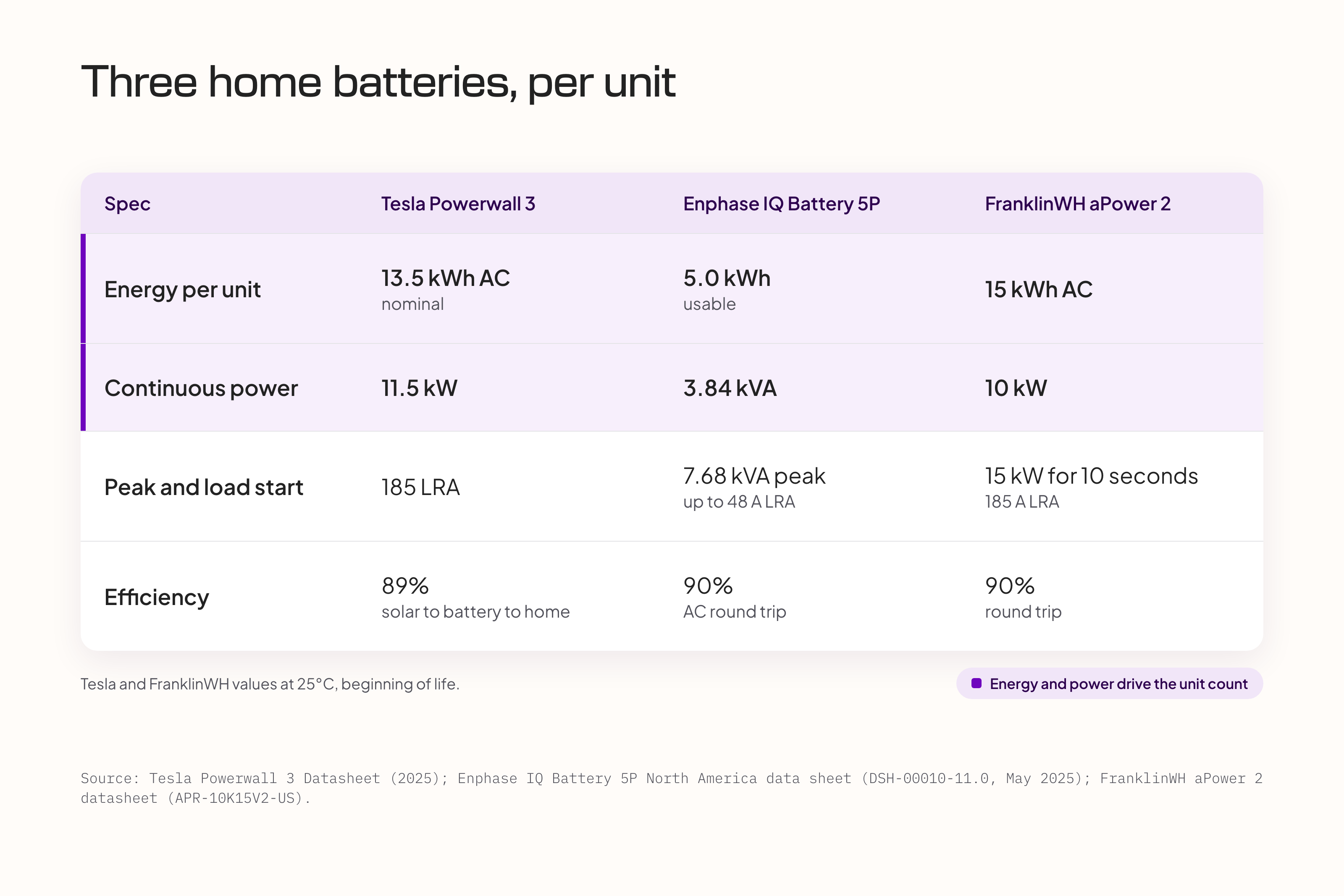

Runtime in hours = usable kWh ÷ average load in kW. Run it backward to size for backup. Here, the homeowner wants 24 hours with no sun to recharge; swap these example loads for your customer's.
That totals 12.0 kWh per day, so energy = 12.0 x (24 ÷ 24) = 12.0 kWh, and with a 10% margin, 12.0 x 1.10 = 13.2 kWh usable. That is 13.2 ÷ 13.5 = 0.98, so one Powerwall 3; 13.2 ÷ 15 = 0.88, so one aPower 2; or 13.2 ÷ 5.0 = 2.64, so three IQ Battery 5P units.
Running together, these loads draw 1,650 W, or 1.65 kW, so continuous power is easy. The real test is the well pump start: compare its nameplate LRA to the battery's load-start rating. Runtime on one 13.5 kWh unit is 13.5 ÷ (12.0 ÷ 24) = 27 hours.

Size to the peak-window load solar can't cover, then confirm midday solar can refill the battery. PG&E's E-TOU-C plan, for example, makes 4 to 9 p.m. the higher-priced peak every day.
An illustrative home uses 30.0 kWh a day. Its interval data shows 11.0 kWh used from 4 to 9 p.m., and the solar design makes 2.0 kWh in that window.
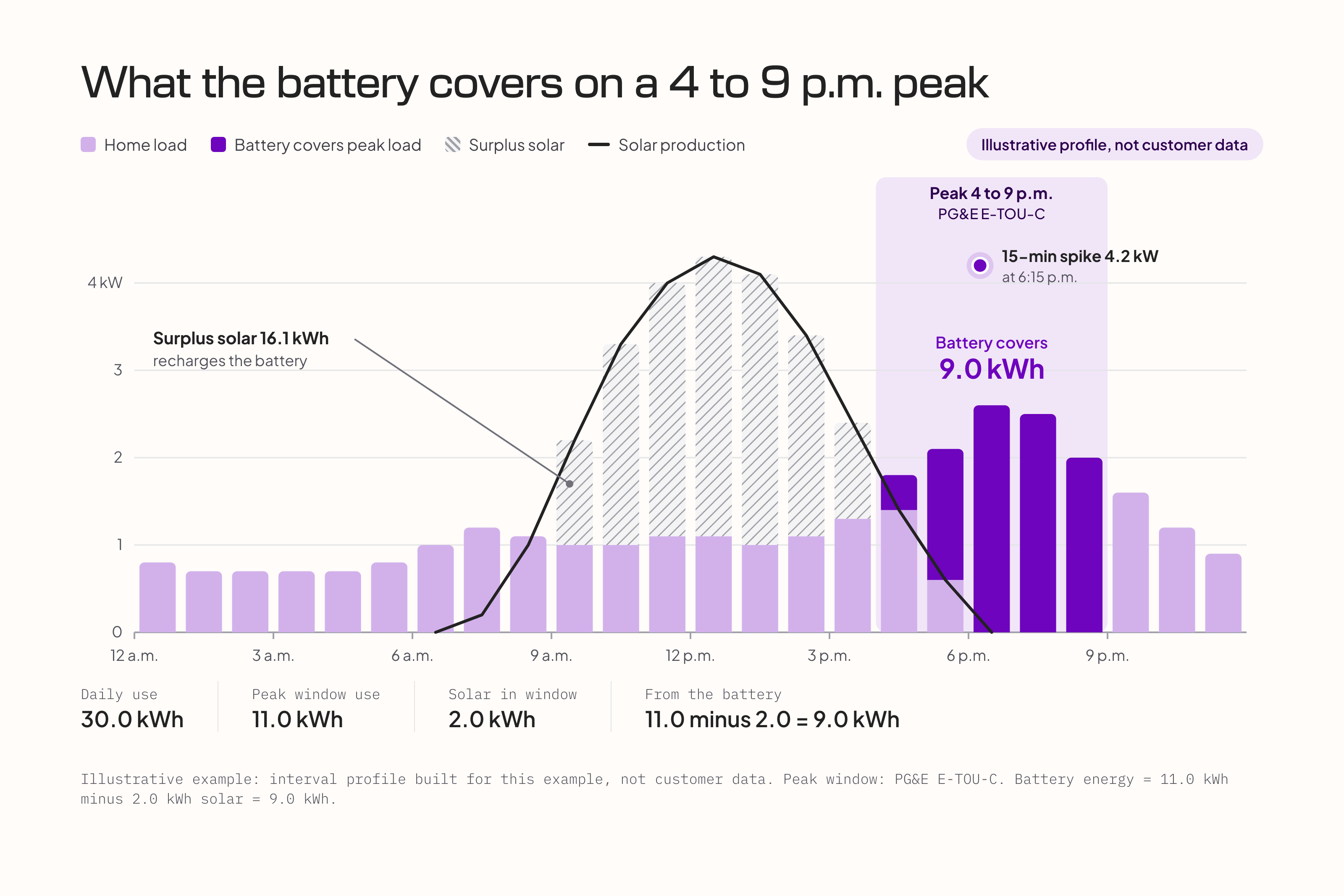
Monthly bills show how much a home used, not when. An average 899 kWh month is about 30 kWh a day; assume flat use and 4 to 9 p.m. looks like 30 x 5 ÷ 24 = 6.25 kWh. The example's interval data shows 11.0 kWh, so the bill-based estimate misses 4.75 kWh every evening.
The data usually exists. About 73% of residential electric meters were smart meters in 2022, and they record use at least hourly, per the EIA.
In Artemis, reps pull utility interval data down to every 15 minutes in under 60 seconds. Our Battery Backup Calculator takes key appliances and backup hours, returns runtime and a sizing recommendation, and compares backup with energy-shift modes. Artemis also auto-sizes battery plans for backup needs, alongside AI Designs that produce a TPO-approved design in under 15 seconds. Financing, including prepaid TPO from Maxwell Power, Participate Energy and Propel, sits in the same workflow, and Presentation Mode shows the options side by side.
Required usable kWh = energy to deliver x (1 + margin) ÷ share available after the backup reserve. Divide by usable kWh per unit, round up, then check continuous kW and load-start rating.
Divide 13.5 by the average load in kW. At 12.0 kWh of critical loads a day (0.5 kW), about 27 hours; at the U.S. average of 29.6 kWh a day (1.23 kW), about 11 hours.
Usable, in AC kWh where the datasheet gives it. Enphase's 5.0 kWh usable already includes a 2% safety limit, so don't subtract it twice.
Both. A battery with plenty of kWh can still fail to start an AC compressor if its load-start rating is below the motor's LRA.
Book a free demo to see 15-minute interval data size the battery inside a live Artemis proposal.


